

Are Lightning Network payments production-ready infrastructure?
For years, Lightning Network payments and crypto payments in general have been boxed into a convenient narrative: a tool for crypto purists, a niche solution for ideologically motivated users, a protocol that never quite crossed into commercial territory.
However, that framing is now outdated. More than 650 million users globally have access to Lightning-enabled wallets. Major crypto apps and digital payment platforms have integrated Lightning Network payments as core infrastructure. What started as a Bitcoin-native protocol has quietly become a functional payment rail, and the businesses paying attention are already building on top of it.
What matters now is whether your payment infrastructure is positioned to move with it.
Key Takeaways:
- Lightning Network payments have moved well past the experimental stage. With over 650 million users accessing Lightning-enabled wallets and network capacity at an all-time high, the infrastructure is operating at commercial scale.
- Scalability in payments means more than handling volume. Settlement speed, fee predictability, liquidity efficiency, and operational resilience are the dimensions that matter, and Lightning addresses each of them directly.
- The biggest barrier to Lightning adoption is a framing problem. Lightning payments behave like high-performance payment infrastructure, not a crypto product. The sectors recognising this earliest are already building on top of it.
- For most operators, the path to Lightning is through adoption rather than self-managed infrastructure. Production-ready payment services now cover the full stack, from pay-ins and payouts to settlements and payment orchestration.
The numbers that changed the conversation
Lightning Network adoption did not grow gradually. It accelerated as infrastructure matured and major platforms made deliberate integration decisions.
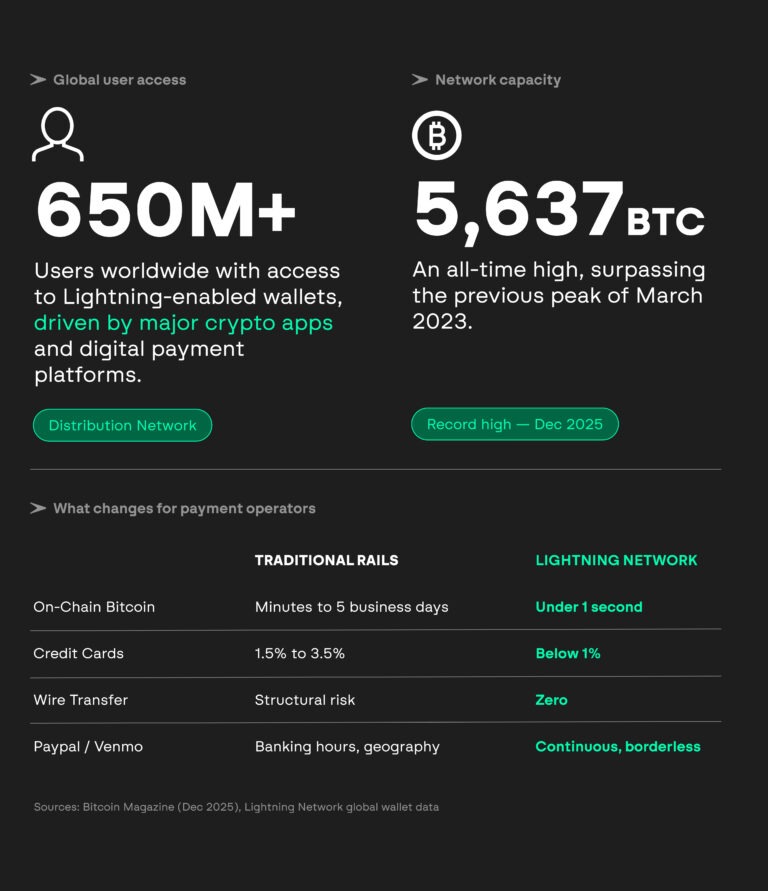
Today, more than 650 million users globally have access to Lightning-enabled wallets, a figure driven largely by leading crypto apps and digital payment platforms embedding Lightning as a native capability rather than an optional add-on. At that scale, this is a distribution network, not a niche user base.
On the infrastructure side, Lightning Network capacity hit a record 5,637 BTC in December 2025, surpassing its previous peak from March 2023. The surge, concentrated in the final months of last year, reflects a meaningful shift. Institutions are actively deploying capital into Lightning channels, increasing the liquidity available for off-chain payments that settle nearly instantly and at minimal fees. More Bitcoin flowing into existing channels means more capacity for commercial-scale transaction volumes.
For payment operators and platform builders accepting crypto payments as part of their infrastructure strategy, these numbers carry a specific meaning. A payment rail with hundreds of millions of accessible users, record channel capacity, and fees below 1% is now a commercially viable infrastructure decision.
What scalability means in payments
Scalability is one of those words that gets used often and defined rarely. In the context of payment infrastructure, it has a precise meaning, and the Lightning Network addresses each dimension of it directly.
Settlement speed under real load is the first test. Traditional payment rails slow down under volume. With Lightning, transactions settle in under a second regardless of network activity, which means platforms processing thousands of payments simultaneously face the same settlement experience as those processing ten.
Fee predictability matters just as much as fee size. A payment rail with low average fees but unpredictable spikes creates margin uncertainty for any business running at high transaction frequency. Lightning fees are low and stable by design, making cost forecasting reliable even as volume grows.
Liquidity efficiency determines whether a payment system can actually sustain growth. Lightning’s channel-based architecture allows businesses to allocate liquidity precisely where it is needed. This reduces idle capital and improves the economics of every transaction.
Then there is operational resilience. When traditional rails experience delays from banking hours, network congestion, or settlement cycles, platforms absorb the friction directly. Lightning Network payments operate continuously, with no dependency on banking infrastructure or geographic clearing windows.
Together, these properties describe a payment rail built for environments where volume is high, margins matter, and downtime is not an option. Platforms evaluating payment infrastructure for scale will recognise these properties. They have nothing to do with crypto ideology and everything to do with operational efficiency.
Why businesses are moving now
The misconception that has slowed Lightning adoption in commercial circles is a framing problem. Lightning gets categorised as a crypto product, which triggers a set of associations: volatility, complexity, regulatory uncertainty, niche user base. None of those associations accurately describe what Lightning does as a payment rail.
In practice, Lightning Network payments behave like high-performance payment infrastructure: sub-second settlement, fees below 1%, zero chargebacks, no dependency on banking hours or geographic clearing cycles, and global reach without the cost structure of correspondent banking. These are characteristics that any Head of Payments or CFO evaluating a new rail would find immediately relevant, independent of any position on cryptocurrency.
The sectors where this is becoming most visible are those where payment friction has a direct and measurable impact on retention and margin. iGaming platforms, for example, operate in an environment where igaming payment options like withdrawal speed and chargeback control are direct retention drivers. Fintech platforms processing cross-border transactions at scale face settlement delays and fee stacks that compound at volume. Digital content platforms running microtransaction models need a rail where the fee per transaction does not erode the economics of the product.
In each of these environments, the adoption decision has already been made. What is being optimised now is execution.
The infrastructure question: build or adopt
Integrating Lightning payments into a business operation goes well beyond deciding to accept Bitcoin. It involves a set of technical and operational considerations that, if underestimated, can slow down deployment significantly.
Running Lightning infrastructure means managing lightning network node operations, channel liquidity, routing logic, and uptime requirements. Each of these has a learning curve and an ongoing operational cost. For businesses whose core product is not payment infrastructure, building and maintaining this stack internally is rarely the most efficient path to market.
This is where the build-versus-adopt decision becomes commercially relevant. The same way most platforms do not build their own card processing stack from scratch, the question with Lightning is whether the operational overhead of self-managed infrastructure justifies the control it offers, or whether a purpose-built integration layer delivers faster, more reliable results.
For most operators, the answer points toward adoption. The Lightning ecosystem has matured to the point where production-ready crypto payment service providers offer pay-ins, payouts, settlements, and payment orchestration via accept crypto payments API, without requiring businesses to manage node infrastructure, liquidity, or routing complexity internally.
Building for what comes next
Lightning was designed to move transactions off-chain while retaining Bitcoin’s security model. What it has become, in practice, is something broader: a payment rail with the properties that high-volume digital platforms actually need, now backed by the capacity and ecosystem to deliver on that promise at scale. And the data reflects that shift.
Lightning Network capacity is at a record high. The user base accessing Lightning-enabled wallets has crossed 650 million. Institutional capital is flowing into channel liquidity. The infrastructure layer supporting commercial integration has matured.
For payment operators and platform builders, this creates a specific kind of strategic moment. The technology has demonstrated it can scale, the ecosystem has developed the tooling to make integration accessible, and the businesses that move now do so before Lightning Network payments become a baseline expectation rather than a differentiator.
If scalability is part of your roadmap, your payment infrastructure is already part of the conversation.
ElenPAY operates as a Lightning Payment Service Provider in this space, enabling businesses accepting crypto payments as part of their growth strategy to integrate Lightning through scalable APIs and an embeddable payment widget. The result is a faster path to live deployment, leaving internal teams focused on growth rather than infrastructure management.
The next stage of your payment infrastructure starts with the right rail. Get in touch with ElenPAY to explore what Lightning can do for your platform.
Lightning Network Payments FAQs
Lightning Network payments are off-chain Bitcoin transactions processed through a network of payment channels. They settle in under a second, carry near-zero fees and operate continuously without dependency on banking infrastructure or geographic clearing windows, making them a viable payment rail for high-volume digital platforms.
A Lightning payment service provider handles the operational complexity of Lightning integration on behalf of a business. This includes node management, channel liquidity, routing logic, and uptime, allowing operators to access Lightning payments through an API or embeddable widget without building or maintaining the underlying infrastructure themselves.
iGaming platforms operate in an environment where payment speed and chargeback exposure directly affect retention and margin. Lightning payments address both. Withdrawals settle in under a second, removing one of the most common friction points for players, while the absence of chargebacks eliminates a structural cost that compounds at volume. Lightning functions as a purpose-built rail for high-frequency, high-stakes payment environments.
The most efficient path for businesses accepting crypto payments via Lightning is through a Lightning payment service provider rather than building and managing node infrastructure independently. A provider handles the operational layer, including channel liquidity, routing, and uptime, and delivers access through an API or embeddable widget. This means businesses can go live with Lightning pay-ins, payouts, and settlements without the overhead of running a lightning network node or managing technical infrastructure internally.