
Competing beyond content: Crypto payment infrastructure has become a core lever for growth
For years, product differentiation, user experience, and acquisition strategies largely defined competition among operators. That dynamic has changed.
Today, operators increasingly compete on the quality of their payment experience, and crypto payment infrastructure has become a central factor in how platforms attract, retain, and scale users. Competition is no longer only about what users play, but about how easily, quickly, and reliably they can move funds in and out of a platform, on their own terms.
Payments have evolved from a background function into a direct growth lever. Users now expect instant deposits and withdrawals, global accessibility, privacy and low-friction payment options that adapt to individual preferences. As crypto payment infrastructure becomes more embedded in payment stacks, it is redefining where competitive advantage is created and where it is lost.

When payment friction becomes a churn trigger
Users now have more payment options than ever before. Cards, bank transfers, digital wallets, peer-to-peer apps, and crypto-based methods coexist within a single platform. This abundance of choice has dramatically reduced user tolerance for friction.
If a payment method fails, takes too long, or does not align with a user’s preferred way of paying, users switch without hesitation. And if a website is not resilient enough to support alternative options when one payment rail fails, users do not wait for platforms to resolve the issue. They move to competitors that offer a smoother, more reliable payment experience.
In this environment, payment reliability and adaptability are no longer operational details. They are now core components of user retention, and increasingly dependent on how robust a platform’s crypto payment infrastructure is.
Crypto payment infrastructure is no longer an alternative option
A competitive payment ecosystem today must meet five essential criteria:
- It must be diverse, offering multiple payment rails to serve different regions, use cases, and user preferences.
- It must be flexible, able to adjust to changing user behavior and merchant requirements without lengthy integrations or heavy dependencies.
- It must be fast, enabling instant deposits and withdrawals that increase conversion, reduce churn, and improve cash flow predictability.
- It must be cost-efficient, offering secure transactions with low, predictable fees that protect margins and diversify payment costs.
- And it must be resilient, capable of operating even when traditional banking or card infrastructure becomes constrained or unreliable.
Operators that rely on a narrow set of payment methods expose themselves to both technical and commercial risk.
Against this backdrop, crypto payments have moved decisively beyond their role as an alternative method. Crypto payment infrastructure is becoming core infrastructure for operators, supporting scale, redundancy, and long-term competitiveness.
This shift is not driven by ideology or experimentation, but by practical benefits. Crypto payment infrastructure reduces dependency on banks and card networks, lowers exposure to chargebacks and payment disputes, and enables faster settlement cycles. Rather than replacing existing payment methods, crypto strengthens the overall payments strategy by adding reach, control, and operational resilience.
Importantly, crypto adoption in payments is being led by users. Operators are integrating crypto payment infrastructure because it reflects how a growing segment of users already prefer to transact.
Why operators are integrating crypto payment infrastructure now
Several factors explain why crypto payment infrastructure is now being integrated at scale:
- It provides market access to users who already hold and use digital assets.
- It enhances operational resilience, particularly in markets where banking access is inconsistent or card acceptance is constrained.
- Industry integration is user-driven. Demand is coming from customers who see crypto as a legitimate and trusted payment option.
In addition, crypto payment rails continue to evolve, improving their ability to meet both user expectations and merchant operational requirements. This evolution has significantly accelerated the adoption of crypto payment infrastructure across the sector in recent years.
The data confirms the shift
Recent data underscores how significant crypto’s role in payments has become.
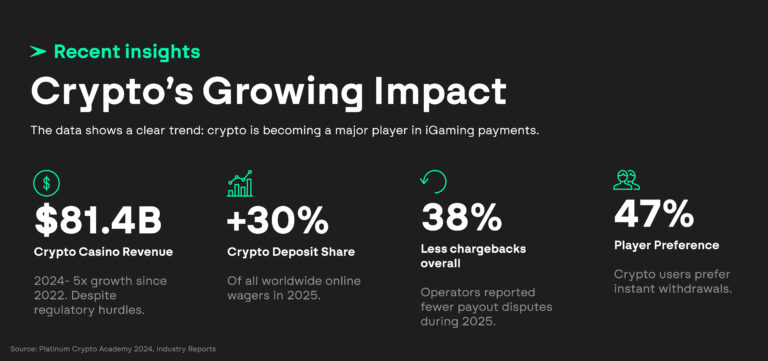
Crypto casino revenue reached $81.4 billion in 2025, representing a fivefold increase since 2022 despite regulatory hurdles. Crypto now accounts for over 30% of worldwide online wager deposits, reflecting meaningful penetration rather than niche usage.
From an operational perspective, operators report 38% fewer chargebacks overall, while 47% of players express a clear preference for instant withdrawals, a feature closely associated with crypto-based payment flows.
Where operators once relied on marginal indicators, today’s data reflects a structural change in how users pay and how platforms must operate to remain competitive. Crypto payment infrastructure is central to this shift.
Adapting crypto to real payment needs
As crypto adoption expanded, it exposed limitations in traditional on-chain payment flows, particularly around speed, cost efficiency, and scalability for everyday transactions. While on-chain payments are well suited for settlement and value transfer, they are not always optimized for high-frequency, user-facing payment interactions.
This is where Lightning payments emerged as one of the most effective crypto payment infrastructure solutions. Lightning is an evolution within crypto payments, designed to deliver instant settlement, lower and more predictable fees, and operational efficiency at scale. By moving transactions off-chain while retaining Bitcoin’s security model, Lightning bridges the gap between user expectations for immediacy and the realities of legacy payment systems.
For users, this means deposits and withdrawals that feel immediate, similar to peer-to-peer payments, rather than traditional settlement flows. For merchants, Lightning enables faster liquidity access, improved cash flow predictability, and the ability to support payment volumes impractical on-chain alone. It allows crypto payment infrastructure to function not just as a settlement layer, but as a day-to-day payment rail aligned with modern platform requirements.
ElenPAY, the Lightning PSP that helps you compete where it matters most
With crypto payments firmly established as core infrastructure, operators that adapt are better positioned to meet user expectations, reduce operational risk, and scale across markets with confidence.
ElenPAY supports operators globally by enabling the integration of Lightning payments as part of a broader, resilient crypto payment infrastructure strategy. Its enterprise-ready solution removes the complexity of managing liquidity, routing, and operational constraints, so operators can focus on what matters most:
- Faster payments.
- Better user experience.
- Greater resilience.
- Confident expansion into new markets.
Why Lightning Payments
Lightning has gained traction because widely adopted crypto wallets globally have integrated the Bitcoin Lightning Network as an off-chain Bitcoin transaction rail. This enables instant, low-fee, and more private Bitcoin payments designed for everyday transactions. By 2025, it is estimated that over 650 million users have access to Lightning-enabled wallets, reinforcing its role as a scalable layer within modern crypto payment infrastructure.
Ready to add Lightning to your payment infrastructure? Book a demo with the ElenPAY team and explore how Lightning can support a more competitive, scalable payment stack.